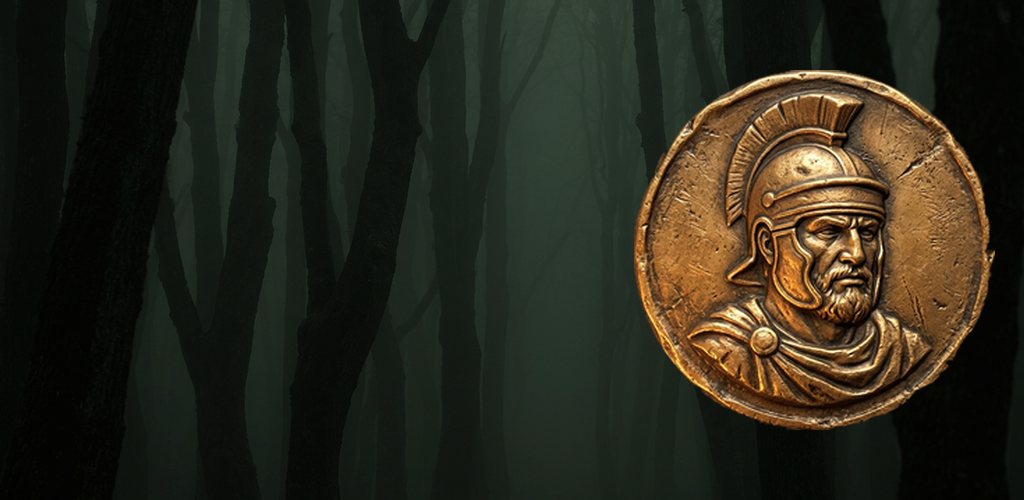
Two armies meet across a ten-by-eight field with a fog-choked no-man’s-land down its middle. Every fight is decided by exact numbers — no dice, no variance — and no piece tells you what it is until it fights or is found out.
Out now on Android · iOS — Windows · Steam in development
What it is
A wargame you can calculate, on a board you cannot see
Chess tells you exactly what every piece is. Stratego hides it. Silva Obscura hides it in a forest, and then makes every fight arithmetic you can do in your head — if you know what you are looking at.
No dice, ever
Attack strength against defence strength. Higher total wins, the loser is removed, and a tie destroys both. Every modifier on the board is a number you can count before you commit, so a lost fight is a mistake and never bad luck.
Nothing says what it is
An enemy piece is an anonymous marker until it fights you or an intel card names it — and then you know it for the rest of the match. Push your general forward where nobody looks for a general. Leave a scout where a bodyguard should stand.
The wood in the middle
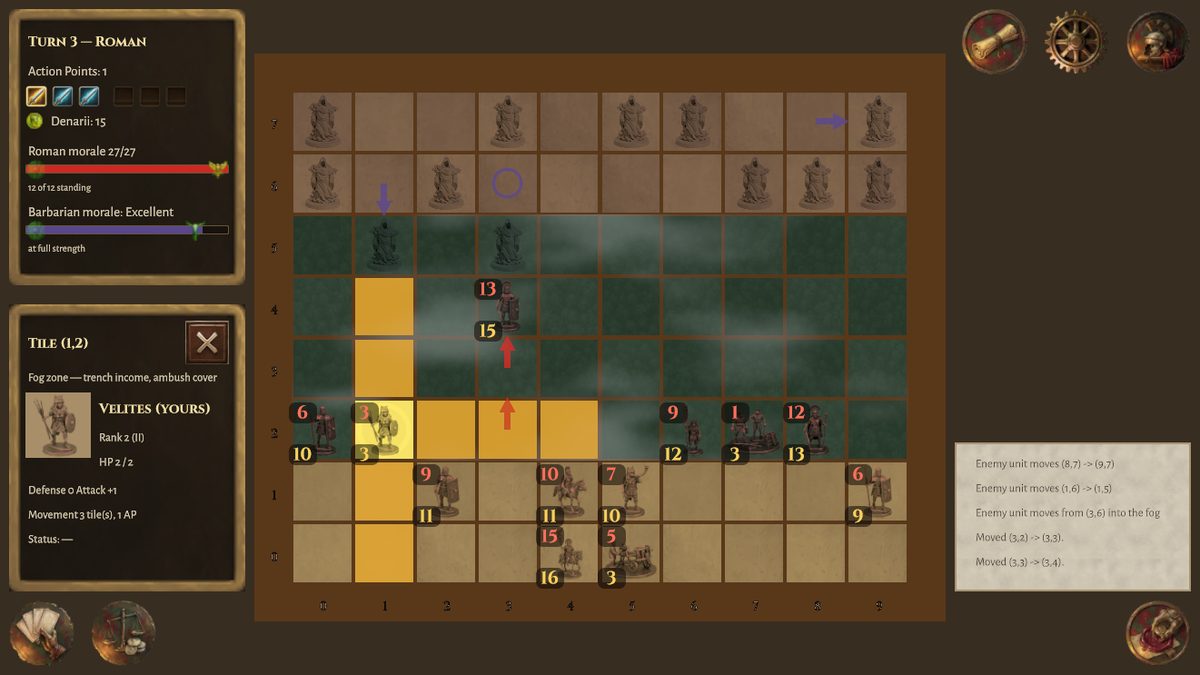
The four central rows are fog. Enemies inside them are invisible unless you stand beside them, sight them with a scout, or light them up with a card. It is also where the money is, which is why nobody can afford to stay out of it.
An army, and a purse
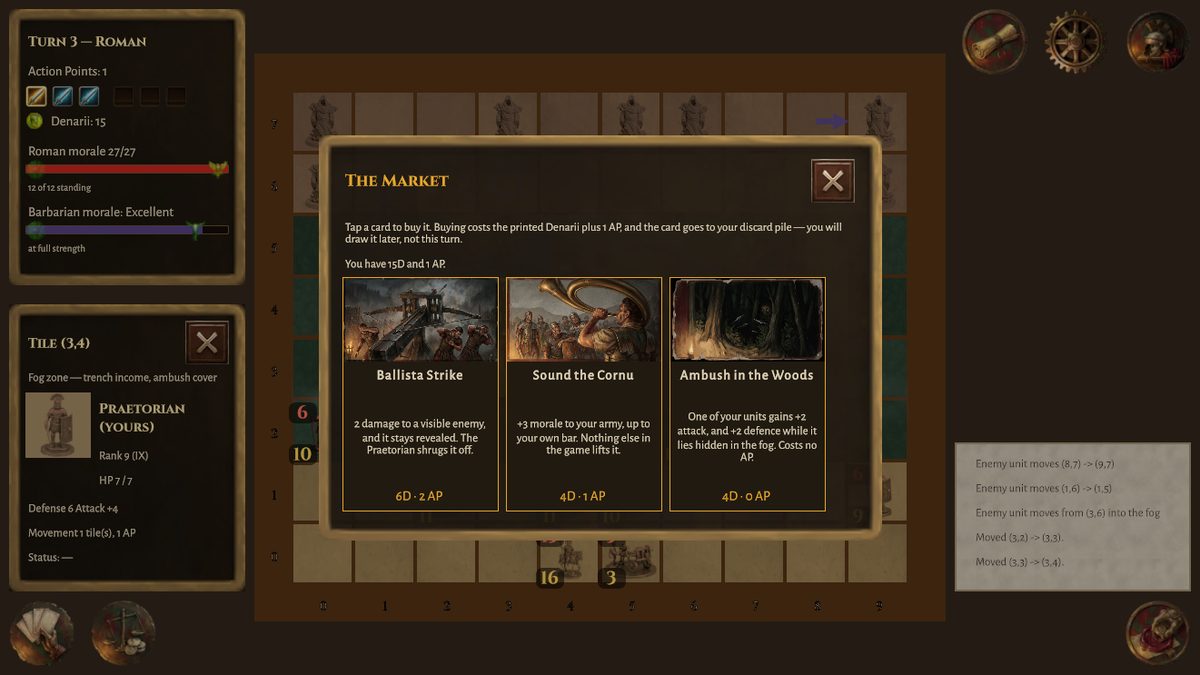
Hold the fog and you draw a Denarius per piece standing in it. Kill something important and you take spoils. Both go on cards from your faction’s stall — march orders, intel, formations, walls, buried ground.
Ground that bites
Wolf-pits, screaming skulls, caltrops, decoy camps, palisades. A trap never refuses a move — you cannot sweep for them by trying — so the only pieces that find one are an engineer beside it, or whatever tread on it first.
Twelve decisions before turn one
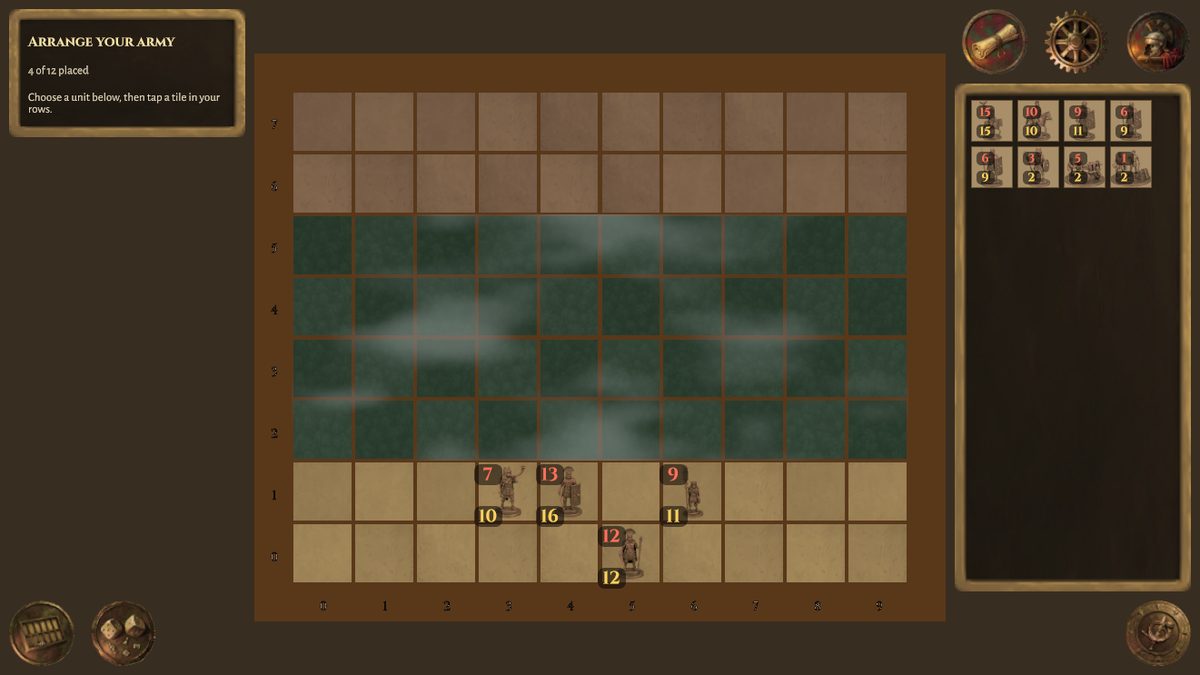
You arrange your own twelve pieces across your two rows, in secret, and your opponent does the same in the same instant. The artillery never moves again, so where it stands is the only decision it ever gets.
How a match goes
Four things happen, in this order
You lay out your army
Twelve pieces, twenty tiles, arranged how you like and seen by nobody. Take the shuffle if you would rather not place them yourself — a randomised army is a real army, not a forfeit.
You spend three action points a turn
A move costs one however far it runs; an attack costs two. March orders buy more, up to a hard ceiling of six — because a third attack in one turn would strip a shield wall faster than it can form.
You go into the fog for money and cover
Income, ambush bonuses and a trench you earn by sitting still for three turns are all in there. So is everything of theirs you cannot see.
Somebody’s King falls — or their nerve does
Kill the enemy general and the match ends on the spot. Break their morale by killing enough of everything else and it ends the slower way. The banner tells you which of the two it was.
The two armies
They are not the same army in two colours
Rome defends by standing together: any legionary in contact with another is harder to kill. The Horde attacks out of cover: any barbarian striking from inside the fog hits harder. Every piece on both sides is built around one of those two sentences.
Faction passive · Testudo
The Roman Legion
Legionary
Praetorian
Legate The King
Slow, armoured and expensive. Artillery that cannot move but deletes what it hits, an engineer who is the only piece in either army that can find buried ground, officers whose horn hurries the line and whose presence wins the fights that would otherwise have killed both.
Faction passive · Frenzy
The Barbarian Horde
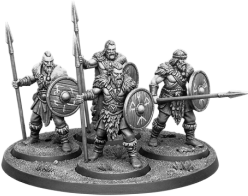
Spear Warband
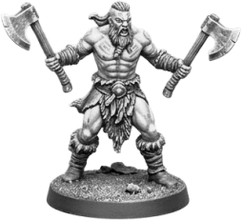
Berserker
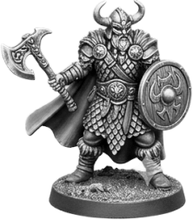
Chieftain The King
Fast, unarmoured and lethal. Chariots that run down anything light regardless of the numbers, a falx that cancels the Roman shield wall outright, and a berserker that kills whoever kills it. Its cards are cheaper than Rome’s and riskier, and most of them are buried in the ground.
Roman Legion
Barbarian Horde
Defence
High — formations
Low — no armour
Movement
Slow and steady
Explosive and hidden
The fog
Defensive — clear it
Offensive — stay inside it
How it wins
Mostly by taking the head
Mostly by breaking morale
Both armies are held inside a 40–60% win band by a test that plays hundreds of matches against itself every time a rule moves, so neither is the one you pick to win.
Screens
The table, by lamplight
Painted miniatures on worn leather, a canopy overhead and the fog drawn thick enough that you will misjudge it at least once a match.
Turn three — three action points, and a scout in the fogArranging twelve pieces, seen by nobodyThree cards face up, each with its price
Ways to play
Against the machine, a friend, or a stranger
Against the AI
The whole game, offline, with no account and no name. An eleven-step guided tutorial plays over a real dealt match, and a field manual generated from the engine itself answers anything it did not cover.
No account needed
Play a friend
Open a private room, read the code out, and both of you arrange your armies at once. Hidden identity holds across the wire: the log says an enemy unit moves, never which one.
Rated
Play a stranger
A queue that pairs you with whoever else is waiting. A result counts only when both sides independently report the same one, so a rating is something two devices agreed on rather than something one of them claimed.
Rated
Trophies & boards
Twenty achievements, awarded by replaying the moves you actually made rather than by trusting the app, and two leaderboards — one for the AI, one for people. Most of the trophies teach you a rule you did not know was there.
Seasonal
What it costs
Free to play, and nothing sold touches the game
Every mode is in the free tier, multiplayer included. The one thing you can buy removes the ads and lets you choose which army you bring — and neither of those changes a single number on a unit, a card, or the board.
Free
The whole game
Every mode: the AI, a friend, a stranger, both leaderboards, all trophies
The tutorial and the in-game field manual
One interstitial ad every third finished match
You play Rome
One-time unlock
Ads gone, army yours
No ads, and the ad SDK stops collecting anything at all
Choose your faction — bring the Horde, and the table turns to face you
Scenarios, on the day they ship
No Denarii, no action points, no cards and no unit power. Ever.
Bought once, restored any time from Settings. See the privacy policy for exactly what the free tier collects and what stops the moment you buy.
The field rules are the complete manual — the board, the turn, the roster of both armies, every card either side can buy and every kind of ground you can bury. The numbers in it are read from the live game, not transcribed by hand.
Contact
Get in touch
YellowGames — Silva Obscura is made by one person, and that person reads the mail.
Bugs, press, a rule you think is wrong, or a data request — all the same address. For anything about your data, say which platform you play on and, if you set one, your in-game display name.